Kochi is no longer just Kerala’s commercial capital it is quietly becoming South India’s next cybersecurity talent hub. The Infopark and SmartCity campuses are home to EY, UST Global, Wipro, Beagle Security, and dozens of security-first product companies, all competing for the same scarce resource: qualified cyber security professionals. Meanwhile, Kerala’s cybercrime case count jumped from 773 in 2022 to 3,295 in 2023 a 327% spike in a single year and incidents keep rising every quarter.
If you are a student, a fresh graduate, or an IT professional in Kochi wondering whether to take the leap into cyber security, the timing has never been better. This guide covers everything you need to make an informed decision: course types, actual fees, eligibility, what the curriculum looks like, and the honest career scope you can expect in 2026 and beyond.
Why Kochi Is the Right City to Study Cyber Security Right Now
Before we get into institutes, it helps to understand why Kochi specifically is worth considering over Bangalore or Hyderabad for your cyber security education.
Proximity to hiring companies. Indeed listed more than 50 active cyber security vacancies specifically in Kochi in early 2026, with employers including EY, Soffit Infrastructure, Beagle Security, WAHY Lab Solutions, and Tedora Hacker Academy. You will not need to relocate to get your first interview.
Kerala Police Cyberdome. Founded in 2015 at Technopark, Thiruvananthapuram, Cyberdome is India’s first public–private partnership cyber intelligence centre. It runs internship tie-ups and cybercrime co-investigation programmes that give local students exposure no online course can replicate.
Lower cost of living. Compared with Bangalore or Pune, Kochi offers comparable IT infrastructure at roughly half the living cost which matters a lot when you are investing ₹25,000 – ₹1,25,000 on a course.
The DPDP Act 2025 demand surge. India’s Digital Personal Data Protection Rules were notified in November 2025, with full compliance required by May 2027 and penalties reaching ₹250 crore for violations. Every company with a Kerala tech footprint is now scrambling to hire data protection and security professionals. Demand is not theoretical it is appearing in job descriptions right now.
Types of Cyber Security Courses Available in Kochi
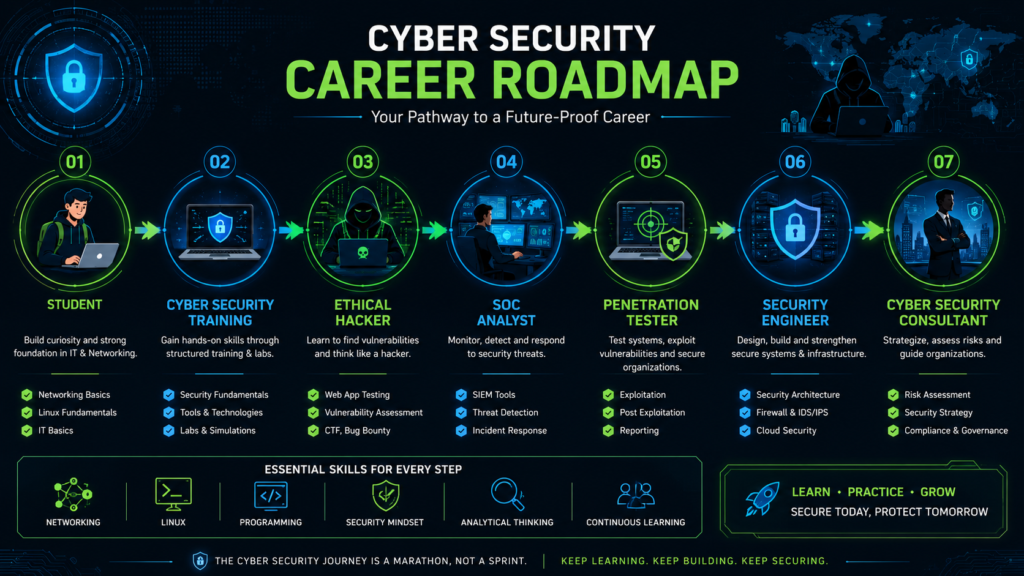
The Kochi market has matured significantly. You are no longer choosing between just a short term crash course and a full B.Tech degree. Here are the main pathways:
Short-Term Certification Courses (1 – 3 Months)
These are the fastest entry points typically 1 to 3 months, covering foundational ethical hacking, network security, or SOC operations. They suit working professionals looking to upskill quickly or students who want to test the water before committing to a longer programme. Best for: IT professionals, BCA/B.Tech students with existing technical exposure.
Diploma & Professional Programmes (2 – 12 Months)
The sweet spot for most students. These structured programmes run between 2 and 12 months and cover multiple security domains from ethical hacking and penetration testing to digital forensics, cloud security, and SOC operations. Offenso Hackers Academy’s flagship Advanced Diploma in Information Security is a 12-month, 14-module programme of this type. Their Offenso Certified Security Professional covers 10 modules in 5 months. Shorter still, the Offenso Certified Security Analyst delivers 10 modules in 2 months for those with some background. Best for: Fresh graduates, final-year B.Tech/BCA/BSc students.
Degree Programmes (3 – 4 Years)
B.Tech in Computer Science with a Cyber Security specialisation, or BSc Cyber Security, from colleges affiliated to MG University, Calicut University, or CUSAT. These provide academic depth but take longer and cost significantly more. They are best combined with an industry certification. Best for: Students who want a conventional college degree alongside practical skills.
Specialised SOC / VAPT / Forensics Tracks (1 – 2 Months)
Focused on one domain. Offenso’s SOC Expert course is a 1-month programme built specifically for aspiring Security Operations Centre analysts one of the highest-demand roles in Kochi’s IT companies right now. Best for: Professionals pivoting from network or systems administration.
Eligibility: Who Can Enrol in a Cyber Security Course in Kochi?
Eligibility varies by course level, but here is the general picture:
For short-term / diploma programmes:
- Minimum 10+2 pass (any stream, though Science/Computer background is preferred).
- Basic computer literacy — being able to install software, use the command line, and understand how the internet works.
- No coding prerequisite for most entry-level courses (though Python basics help).
For advanced / professional programmes:
- B.Tech, BCA, BSc Computer Science, MCA or equivalent degree or final-year students about to graduate.
- Some institutes accept non-technical graduates (commerce, arts) into beginner tracks, provided they complete a bridge module on networking fundamentals.
For EC-Council CEH v13:
At least 2 years of work experience in the Information Security domain or successful completion of an EC-Council approved training programme (which waives the experience requirement)
For OSCP:
No formal academic requirement. OffSec recommends familiarity with Linux, basic scripting, and TCP/IP networking before purchasing PEN-200 access.
Can a 12th-pass student enrol? Yes into diploma and certification programmes at Offenso and similar institutes. The Certified Junior WhiteHat Hacker programme, for example, is specifically designed for school students in Grade 6–12 who want an early introduction to ethical hacking and cyber safety. Many of Offenso’s own alumni including Viswalakshmi, Diya, and Divya listed on their placement board began right after their Plus Two.
What Does the Curriculum Cover?
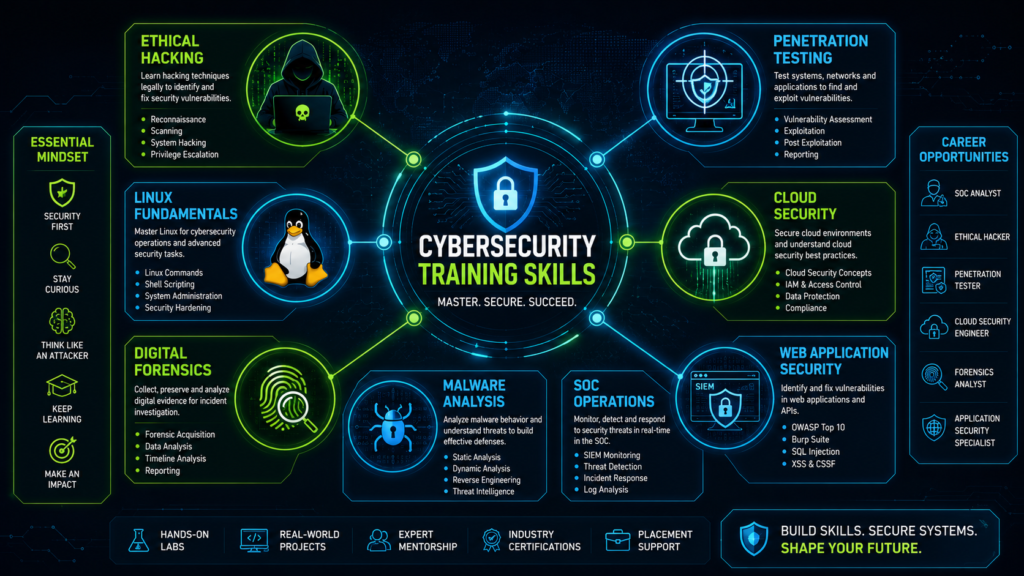
A well-structured cyber security course in Kochi should cover these core domains. Use this as a checklist when evaluating any institute
- Networking fundamentals — OSI model, TCP/IP, subnetting, DNS, HTTP/S protocols.
- Linux & command-line basics — file permissions, bash scripting, process management.
- Ethical hacking methodology — reconnaissance, scanning (Nmap, Masscan),
enumeration, exploitation, post-exploitation, reporting. - Web application security — OWASP Top 10 (2025 edition), SQL injection, XSS, CSRF,
IDOR; hands-on with Burp Suite. - Network security & traffic analysis — Wireshark, firewall configuration, IDS/IPS.
- System hacking — password cracking (Hashcat, John the Ripper), privilege escalation,
lateral movement. - Malware analysis & incident response — static and dynamic analysis, SIEM basics, log
correlation. - Cloud security — AWS/Azure misconfigurations, S3 bucket security, cloud pentesting.
- Mobile security — Android APK analysis, ADB exploitation.
- Digital forensics — evidence collection, chain of custody, Autopsy, Volatility.
- Compliance & law — Indian IT Act 2000, CERT-In directives, DPDP Act 2025, data breach
notification timelines.
The best institutes including Offenso Hackers Academy supplement classroom modules with Capture The Flag (CTF) competitions, live penetration testing labs, and mock interviews. Ask specifically about the ratio of hands-on lab hours to theory before enrolling.
Career Scope After a Cyber Security Course in Kochi
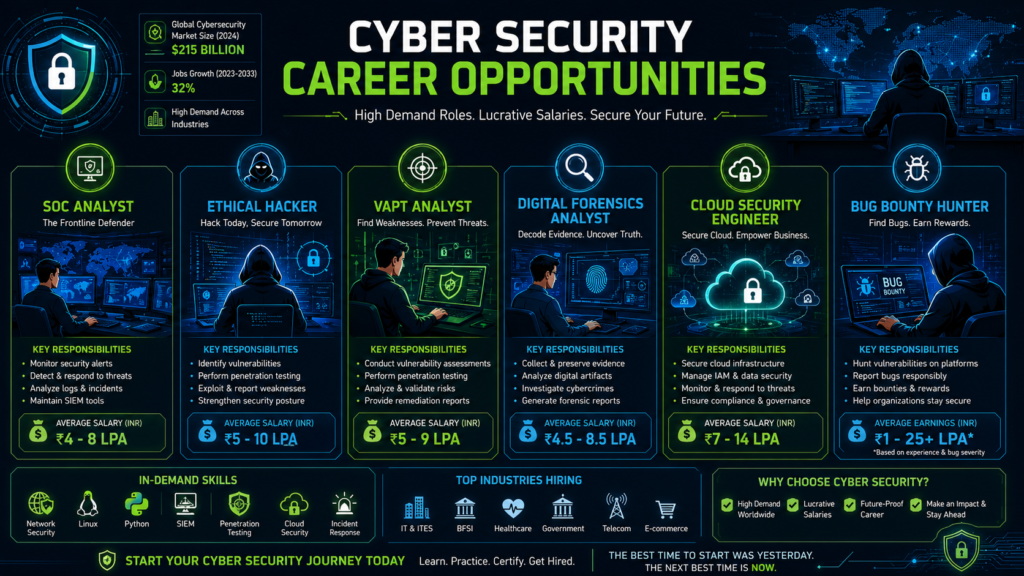
Here is where the conversation gets exciting. Kochi’s cyber security job market is no longer a stepping-stone to Bangalore it is a destination in its own right.
Roles You Can Target
- Security Operations Centre (SOC) Analyst (Tier 1–3): The most accessible entry role. Companies like Beagle Security, UST Global, and EY’s Kochi office actively hire L1 analysts.
- Penetration Tester / Ethical Hacker: VAPT engagements for banks (Federal Bank, South Indian Bank, Catholic Syrian Bank — all headquartered in Kerala), hospitals, and fintech companies.
- VAPT Analyst: Specific to vulnerability assessment; high demand in Kerala’s banking and healthcare sectors.
- Security Analyst – GRC: Driven by the DPDP Act 2025, GRC (Governance, Risk & Compliance) is becoming one of the fastest-growing roles in 2026.
- Digital Forensics Analyst: Supporting Kerala Police’s Cyberdome and private incident response engagements.
- Bug Bounty Hunter: Freelance / remote; several Offenso alumni earn ₹10,000 – ₹5,00,000 per quarter through platforms like HackerOne and Bugcrowd.
The Bottom Line
A cyber security course in Kochi in 2026 is not a gamble it is one of the clearest career investments available to a Kerala student or IT professional today. The demand is real, the hiring companies are local, the salaries outpace almost every other tech role at the same experience level, and the city’s growing ecosystem of cyber agencies, CTF communities, and the Kerala Police Cyberdome means your learning does not stop when the course ends.
