
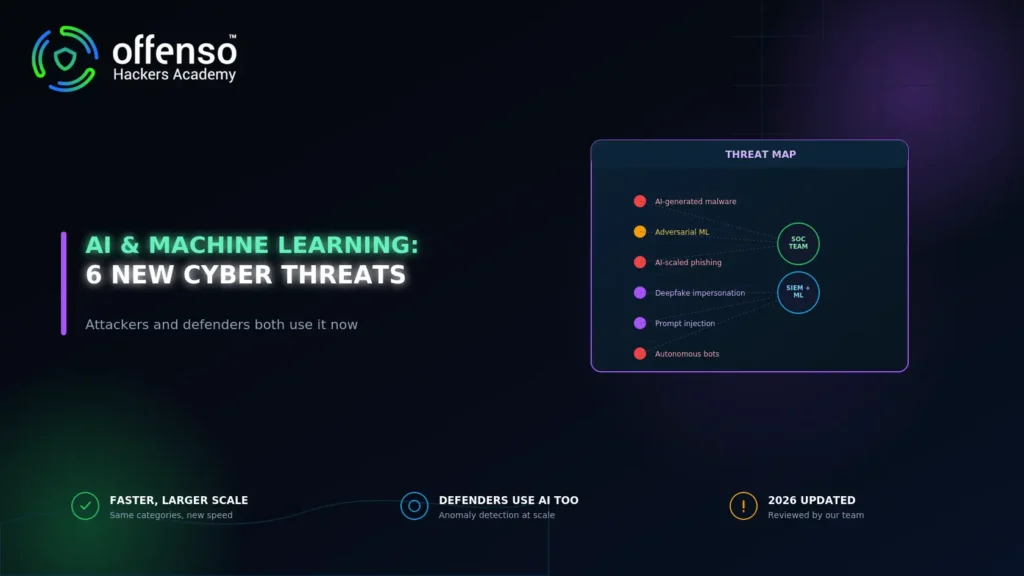
AI and machine learning are creating more sophisticated cybersecurity threats by letting attackers automate, personalize, and scale attacks that used to require significant manual effort from malware that rewrites itself to evade detection, to phishing content that’s individually tailored to thousands of targets at once. The underlying attack categories aren’t entirely new; what’s changed is speed, scale, and how convincing the output has become.
Why AI Changes the Threat Equation
Before AI tooling became widely accessible, sophisticated attacks required real skill and real time a convincing phishing email took a human writer, a piece of evasive malware took a skilled developer, a believable fake voice took real effort. AI collapses that cost. The same output that once took an experienced attacker hours can now be generated in seconds, and at a volume no human team could match manually.
This is genuinely different from earlier waves of automation. Older attack tools followed fixed scripts. AI-driven ones adapt testing what works, adjusting content or approach based on results, and improving without a human rewriting the code each time.
6 Ways AI and Machine Learning Are Reshaping Cyber Threats
- AI-generated and polymorphic malware — malicious code that rewrites its own structure to evade signature-based detection, covered in depth below.
- Adversarial attacks against machine learning models — deliberately feeding manipulated data to fool AI systems themselves, also covered below.
- AI-scaled social engineering — personalized phishing and pretexting generated at a volume manual writing never could reach, covered below.
- Deepfake-based impersonation — synthetic audio and video used to impersonate real people for fraud; see our full breakdown in Deepfake Attacks Explained.
- Prompt injection against AI systems — manipulating the inputs of AI tools and assistants to bypass their intended behavior; covered in detail in our prompt injection guide.
- Autonomous attack tooling — AI-driven bots that scan, probe, and exploit vulnerabilities with limited human oversight; see Autonomous Hacking Bots for the full picture.
The rest of this guide focuses on the three that don’t yet have dedicated coverage on our blog.
AI-Generated and Polymorphic Malware
Traditional antivirus tools largely rely on recognizing known malware signatures a kind of digital fingerprint. Polymorphic malware defeats this by changing its own code structure each time it replicates or spreads, while keeping its underlying malicious function intact. AI tooling makes generating these variations faster and more sophisticated than earlier automated mutation techniques could manage.
The practical effect is that signature-based detection alone is no longer sufficient on its own. Modern defense increasingly relies on behavioral detection watching what a program actually does once running, rather than just what it looks like on disk which is exactly the kind of pattern-based analysis a SIEM and a trained SOC analyst are built around.
This shift also changes what a malware analyst actually spends time doing. Instead of comparing a suspicious file against a database of known signatures, the work increasingly involves observing behavior in a sandboxed environment: what does this program actually try to do once it runs, regardless of what its code looks like on the surface. That skill doesn’t become obsolete as malware gets more sophisticated if anything, it becomes the primary line of defense once static signatures stop being reliable.
Adversarial Attacks Against Machine Learning Models
This category flips the usual script: instead of AI being the attacker’s tool, the AI system itself becomes the target. Adversarial machine learning involves feeding a model deliberately crafted, manipulated input designed to make it misclassify something causing a spam filter to let malicious email through, or a fraud-detection model to approve a fraudulent transaction, without the input looking obviously suspicious to a human reviewer.
This matters more every year because organizations are deploying more AI-driven security tools themselves meaning the AI meant to defend a system can itself become an attack surface if it isn’t tested for this specific weakness. Frameworks like MITRE’s ATLAS, which catalogs real-world adversarial machine learning tactics, exist specifically because this category of risk has become common enough to need its own structured reference, separate from traditional attack frameworks.
Testing an AI model against this kind of manipulation is a genuinely different skill from testing a traditional web application it requires understanding both how the model was trained and how an attacker might exploit gaps between what the model was trained on and what it encounters in the real world. This is a relatively new specialization even within cybersecurity, and demand for people who understand it is growing faster than the supply of people who actually do.
AI-Scaled Social Engineering
Traditional phishing relied on generic messages sent to large lists, hoping a small percentage would fall for it. AI-generated content changes the economics messages can be individually tailored using publicly available information about a specific target, generated at a volume and quality that previously required a dedicated human effort per victim.
This is precisely why security awareness training keeps shifting focus: away from “look for bad grammar” (an old, increasingly unreliable signal) and toward verifying requests through a second channel, since AI-generated text no longer reliably gives itself away through obvious errors.
How Defenders Are Fighting Back With AI Too
The same underlying technology cuts both ways. Security teams increasingly use machine learning for anomaly detection flagging behavior that deviates from an established baseline faster than a human reviewing logs manually ever could. Modern SIEM platforms build correlation and risk-scoring directly around this kind of pattern recognition, which is part of why understanding both the attacking and defending sides of AI-driven security has become a genuinely valuable, dual-purpose skill rather than two separate specialties.
Organizations focused on responsible AI security testing increasingly reference guidance like OWASP’s Machine Learning Security Top 10, which catalogs exactly the kind of adversarial and data-poisoning risks discussed above.
What This Means If You’re Building a Security Career Now
None of this makes fundamentals obsolete if anything, it makes them more important. Understanding networking, log analysis, and how detection actually works underneath the AI layer is what lets someone evaluate whether an AI-driven security tool is actually working correctly, rather than trusting a dashboard blindly. The organizations hiring for these skills aren’t just looking for people who can use AI tools; they want people who understand what’s happening underneath them well enough to catch when something’s wrong.
This is exactly why hands-on, fundamentals-first training matters more as AI-driven attacks grow more common, not less. If you’re mapping out your own path into this field, our guide on how to become an ethical hacker walks through the foundational steps this all builds on.
AI and Machine Learning Cybersecurity Threats FAQ
Are AI-generated cyberattacks actually more dangerous than traditional ones? Not necessarily more dangerous in kind, but often more dangerous in scale and speed AI lets attackers personalize and mass-produce content that previously required significant manual effort per target.
Can AI be used to defend against AI-generated threats? Yes. Machine learning is widely used defensively for anomaly detection and behavioral analysis, often to identify the same kind of pattern-based attacks that AI tools are used to generate.
What is adversarial machine learning? It’s the practice of deliberately feeding manipulated input to an AI model to cause it to make an incorrect decision, such as misclassifying malicious content as safe.
Do traditional antivirus tools still work against AI-generated malware? Signature-based detection alone is less effective against polymorphic, AI-assisted malware, which is why modern defense increasingly relies on behavioral detection instead of, or alongside, signature matching.
Is it still worth learning cybersecurity fundamentals given how fast AI threats are evolving? Yes fundamentals like networking, log analysis, and detection logic are what let someone evaluate whether an AI security tool is actually working, making them more valuable as AI-driven attacks become more common, not less.
Published Date: July 25, 2026