
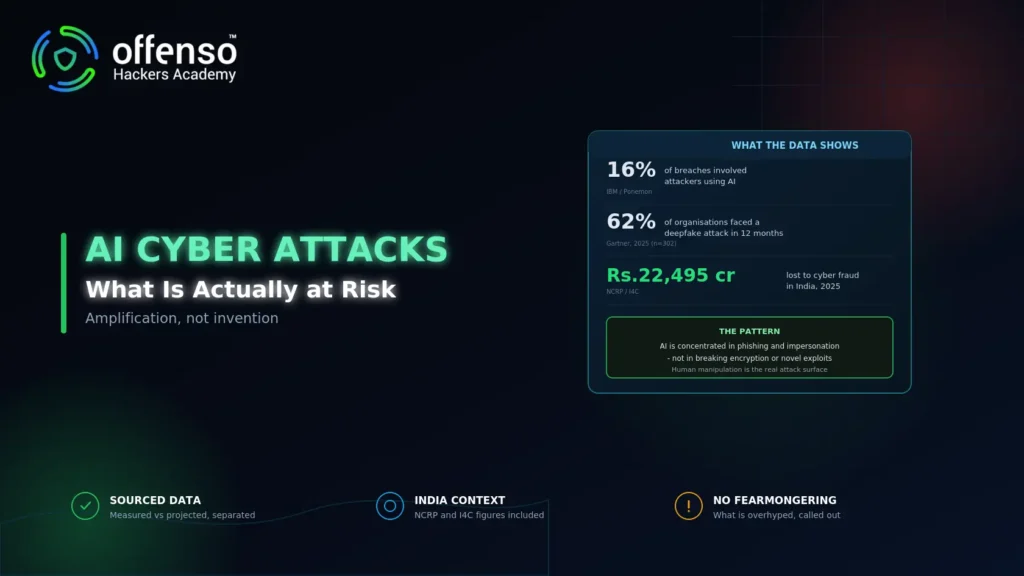
AI cyber attacks are real, measurable, and growing but the data tells a more specific story than the headlines do. According to IBM and Ponemon Institute breach research, roughly 16% of breaches involved attackers using AI, and critically, those AI-driven tactics were concentrated in phishing and deepfake-enabled manipulation rather than novel exploitation at scale. In other words: AI is making the oldest attack in the book work better, not inventing an unstoppable new one.
That distinction matters enormously for how you should actually respond.
What the Data Actually Shows About AI Cyber Attacks
Here’s what has been measured, separated from what has been projected:
| Finding | Source | Type |
|---|---|---|
| ~16% of breaches involved attackers using AI | IBM / Ponemon breach research | Measured |
| 62% of organisations faced at least one deepfake attack in a 12-month period (n=302 security leaders) | Gartner, 2025 | Survey |
| Synthetic text in malicious emails doubled over two years | Verizon Data Breach Investigations Report | Measured |
| 859,532 complaints and $16.6B in reported losses (2024, US) | FBI Internet Crime Complaint Center | Measured |
| US generative-AI-enabled fraud losses rising from $12.3B (2023) to $40B by 2027 | Deloitte Center for Financial Services | Projection, not measured |
That last row matters. A large share of the alarming numbers circulating about AI cyber attacks are forward-looking projections, not counts of what has already happened. Both are useful, but they are not the same thing, and treating a 2027 forecast as a present-day fact leads to bad decisions.
The Pattern: Amplification, Not Invention
Across the credible research, one pattern repeats: AI is concentrated in human manipulation, not in breaking cryptography or discovering exotic new vulnerabilities.
Attackers use AI to write more convincing phishing emails, clone a voice from a publicly available recording, generate a synthetic video of an executive, and personalise all of it at a volume no human team could match. What they largely are not doing is using AI to invent fundamentally new categories of attack.
This is why the practical defence has shifted. The old advice “look for bad grammar and spelling mistakes” is now close to useless, because AI-generated text has no grammar tells. The advice that replaces it is procedural: verify unusual requests through a second, separate channel before acting on them.
Where the Real Risk Sits Today
For individuals:
- Voice-cloning scams targeting family members, using audio scraped from social media
- Highly personalised phishing that references real details about your job, employer, or recent activity
- Investment and job-offer scams with AI-generated supporting material that looks legitimate
For businesses:
- Business email compromise, where a synthetic voice or video is used to authorise a payment
- Credential harvesting at scale through convincing fake login pages
- Identity verification systems being tested by synthetic faces and documents
Notice that almost every item on both lists depends on a person being convinced to do something. That is the actual attack surface AI has expanded.
AI Cyber Attacks in India: The Local Picture
India’s exposure is shaped by the sheer scale of its digital economy. According to data reported through the National Cyber Crime Reporting Portal, Indians lost roughly ₹22,495 crore to cyber fraud in 2025, across approximately 28.15 lakh reported cases a 24% rise in complaint volume year on year, even as the rupee total stayed broadly flat.
Two details are worth pulling out:
- Investment scams account for around 76% of the money lost, making them by far the dominant category not exotic AI malware.
- “Digital arrest” scams accounted for roughly 9% of losses, a purely psychological attack in which fraudsters impersonate law enforcement over video call. No genuine Indian agency police, CBI, or ED conducts arrests or investigations over a video call. That is always a scam.
The Indian Cyber Crime Coordination Centre (I4C) has blocked over ₹8,031 crore in fraudulent transactions since inception, and the 1930 helpline exists specifically for rapid reporting, where speed materially affects the chance of recovering funds.
Again, the pattern holds: the biggest losses come from manipulating people, and AI makes that manipulation cheaper and more convincing rather than replacing it with something else.
What Is Genuinely Overhyped
Being honest about this matters, because inflated fear leads to the wrong investments:
- “AI has made encryption useless.” It hasn’t. Properly implemented modern encryption remains sound; attackers go around it via weak keys, poor implementation, and stolen credentials the same as before.
- “AI can now hack anything autonomously.” Autonomous security tooling exists and is improving, but the measured breach data shows AI concentrated in phishing and impersonation, not automated exploitation at scale.
- “Nothing you do matters anymore.” The opposite is closer to true. Because the attack vector is largely human manipulation, human-layer defences verification procedures, MFA, awareness training remain highly effective.
So Is It Safe? An Honest Answer
Safer than the headlines imply, and less safe than most people behave.
The realistic position: your risk of encountering an AI-assisted scam has gone up meaningfully, and your risk of spotting it by instinct alone has gone down, because the surface-level tells that used to give scams away are gone. But the underlying protections that worked before still work, and the fundamentals have not been rendered obsolete by any of this.
What has genuinely changed is that you can no longer rely on something “looking wrong.” Verification has to become procedural rather than intuitive.
What Actually Protects You
- Verify through a second channel. If a message, call or video asks for money, credentials, or urgent action, confirm through a separate, known-good contact method before acting.
- Use multi-factor authentication everywhere it’s offered. Stolen credentials remain a primary path in, and MFA blocks a large share of that.
- Treat urgency as a warning sign, not a reason to move faster. Manufactured urgency is the common thread across nearly every scam category.
- Keep software patched. Unpatched systems remain a far more common entry point than anything AI-specific.
- Report quickly. In India, the 1930 helpline and cybercrime.gov.in exist for exactly this, and early reporting measurably improves recovery odds.
Why Trained People Still Matter More Than Tools
There’s an assumption that AI attacks require AI defences, and that this somehow removes the human from the equation. The measured evidence points the other way.
Because AI-driven attacks concentrate on manipulating people and exploiting weak verification workflows, the defences that matter are procedural and human: knowing what a suspicious pattern looks like in a log, recognising when an automated alert is a false positive, and building verification steps that hold up when the content itself is indistinguishable from genuine.
That work requires people who understand systems at a level deeper than the tools they operate. Frameworks like MITRE ATT&CK exist precisely because knowing the actual techniques attackers use is what allows a defender to evaluate whether an automated finding maps to a real threat.
At Offenso, that grounding is what the training is built around hands-on lab work in network, web and defensive security rather than tool familiarity alone. If you’re weighing where to start, our guide on how to become an ethical hacker walks through the path, and our breakdown of AI and machine learning cybersecurity threats covers the specific attack types in more technical depth.
AI Cyber Attacks FAQ
Are AI cyber attacks actually more dangerous than traditional ones? More dangerous in scale and believability, rather than in kind. Breach research shows AI concentrated in phishing and deepfake impersonation rather than novel exploitation, meaning the attack types are familiar but far more convincing and produced at higher volume.
Can AI break encryption? No. Properly implemented modern encryption remains sound. Attackers bypass encryption through weak keys, poor implementation and stolen credentials rather than defeating the mathematics.
How do I spot an AI-generated phishing message? Surface-level tells like poor grammar are no longer reliable. The dependable approach is procedural: verify any request for money, credentials or urgent action through a separate, known-good channel before acting.
What should I do if I fall victim to an AI cyber attack in India? Report immediately through the 1930 helpline or cybercrime.gov.in. Early reporting significantly improves the likelihood of funds being frozen or recovered.
Is multi-factor authentication still effective against AI cyber attacks? Yes. Because a large share of AI-assisted attacks aim to harvest credentials, MFA remains one of the most effective single protections available.
Do AI cyber attacks mean cybersecurity skills are becoming obsolete? The evidence points the other way. As attacks concentrate on manipulating people and exploiting weak verification, the demand for professionals who understand systems well enough to design and validate those defences increases rather than decreases.
Published Date: August 22, 2026