
If you’re planning a cybersecurity certification this year, you’ve almost certainly hit the same fork in the road: CompTIA Security+ vs Certified Ethical Hacker (CEH)? Pick the wrong order and you can waste three to six months and tens of thousands of rupees sitting an exam you weren’t ready for.
Here’s the short answer: most people should take Security+ first. It’s entry-level, far cheaper, and builds the defensive foundation that CEH quietly assumes you already have. But “most people” isn’t you, and the right sequence genuinely depends on your experience, budget, and the role you’re chasing. This guide breaks down both certifications, the differences that actually decide the order, and a clear way to choose based on your situation.
Security+ vs CEH at a Glance
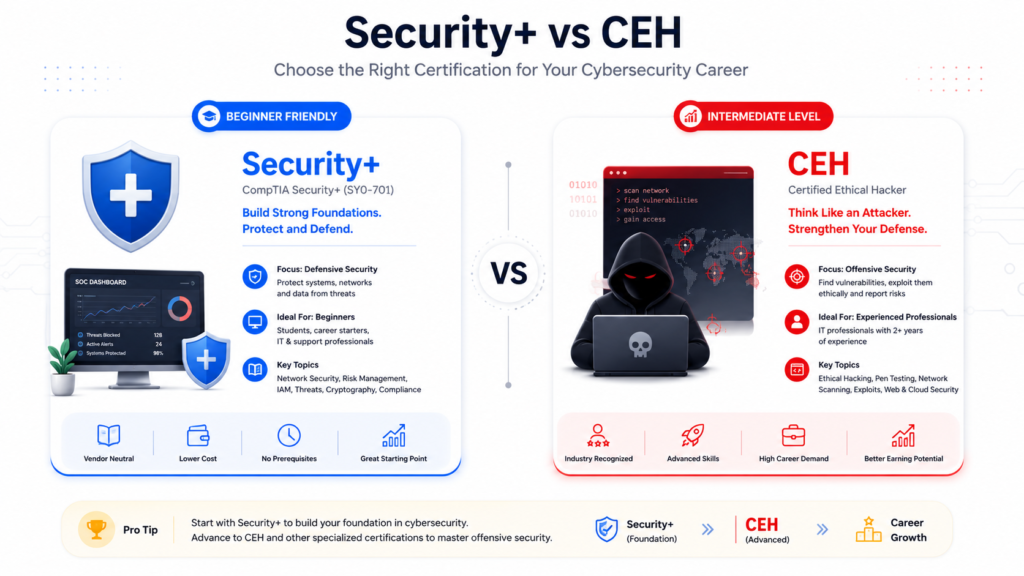
| CompTIA Security+ (SY0-701) | CEH v13 (312-50v13) | |
| Level | Entry-level / foundational | Intermediate |
| Focus | Defensive broad security fundamentals | Offensive ethical hacking techniques |
| Exam | Up to 90 questions, 90 minutes | 125 questions, 4 hours |
| Passing score | 750 / 900 | Variable, 60–85% |
| Cost | ₹38,000 voucher | ₹1.13 lakh voucher + ₹9,500 application fee |
| Prerequisites | None required | 2 years experience or official training |
| Validity | 3 years (50 CEUs to renew) | 3 years (120 ECE credits to renew) |
| Best for | Newcomers, SOC/security admin roles | Aspiring pen testers, government roles |
What Is CompTIA Security+ (SY0-701)?
CompTIA Security+ is the most widely recognized entry-level cybersecurity certification in the industry. It validates that you understand core security concepts threats and vulnerabilities, security architecture, security operations, risk and compliance well enough to step into a working security role.
Who Security+ is for
Security+ is built for people moving into cybersecurity: career changers, IT support staff levelling up, and students. There are no formal prerequisites, though CompTIA
recommends Network+ knowledge and a couple of years of general IT experience. If you can’t yet explain the CIA triad, zero trust, or how a SOC analyst spends their day, this is your starting line.
Exam format, cost, and validity
The current version is SY0-701, launched in November 2023. The exam runs up to 90 questions (multiple-choice plus performance-based scenarios) in 90 minutes, with a passing score of 750 on a 100–900 scale. The standalone voucher costs roughly ₹38,000 (the global price is set in USD at about $404, so the rupee figure shifts with the exchange rate), and the certification stays valid for three years, renewable with 50 continuing education units.
One currency note for 2026: CompTIA refreshed the SY0-701 objectives in mid-2026 adding generative-AI security risks, CMMC 2.0, and expanded supply-chain content with the updated objective set going live July 1, 2026. The exam code stays the same, so any SY0-701 study material aligned to the latest objectives remains valid.
Skills and roles it unlocks
Security+ maps cleanly to roles like SOC analyst, security specialist, security administrator, and IT security analyst. Crucially, it’s on the DoD 8140 Qualification Matrix as an IAT Level II baseline, which is why it shows up as a hard requirement in a large share of US federal and contractor job postings.
What Is the Certified Ethical Hacker (CEH v13)?
The Certified Ethical Hacker, from EC-Council, validates your ability to assess systems using the same tools and techniques as malicious hackers but legally, and with
permission. Where Security+ teaches you to defend, CEH teaches you to attack so you can find weaknesses before real adversaries do.
Who CEH is for
CEH sits at the intermediate level, between foundational certs like Security+ and advanced offensive credentials like OSCP. It suits people who already have hands-on security exposure and want to prove offensive skills for roles in penetration testing, vulnerability assessment, or red teaming. The current version, CEH v13, is marketed as the first AI integrated ethical hacking curriculum, folding AI attack-and-defence into every phase rather than treating it as an add-on.
Exam format, cost, and eligibility
The CEH v13 knowledge exam is 125 questions over 4 hours, scored on a variable scale (the cut score floats between roughly 60% and 85% depending on the question pool). The self-study voucher runs about ₹ 1.13 lakh (roughly $1,199, set in USD), plus a ₹ 9,500 non refundable application fee (about $100) if you don’t take official training. And here’s the eligibility wall: to sit CEH without paid EC-Council training, you must provide proof of two years of information-security work experience. Renewal requires 120 ECE credits over three years.
Skills and roles it unlocks
CEH covers 20 modules and 550+ attack techniques reconnaissance, scanning, exploitation, web and wireless attacks, cloud and IoT security. It maps to penetration tester, vulnerability analyst, and red-team roles, and like Security+, it’s recognized under DoD 8570/8140, which keeps it on government and contractor checklists.
Security+ vs CEH: The Differences That Decide the Order
Is CEH harder than Security+?
Yes meaningfully. Security+ tests broad fundamentals in a 90-minute exam. CEH throws 550+ attack techniques at you across a four-hour, 125-question exam and assumes you already understand TCP/IP, Windows and Linux internals, and basic scripting. If those aren’t second nature yet, CEH will feel like it’s from a different planet.
The cost gap is real
This is where the sequence often gets decided for you. Security+ is roughly a ₹38,000 commitment. CEH’s voucher alone is about ₹1.13 lakh, plus the ₹9,500 application fee and most self-studiers end up buying training or labs on top. All in, CEH commonly runs three to four times the cost of Security+. Failing it first try means another voucher, so readiness matters more here.
Prerequisites — can you even sit CEH first?
This is the question that quietly removes the choice for newcomers. Security+ has no prerequisites. CEH requires either official (paid) training or two years of verifiable
security experience. If you have neither, you literally can’t take CEH first without paying for the training pathway which is exactly why the “which first” debate ends before it begins for most beginners.
Defensive vs offensive focus
Security+ is defensive and broad: protect, monitor, comply. CEH is offensive and specialized: probe, exploit, report. The two are complementary, not redundant Security+ teaches you what you’re defending; CEH teaches you how it gets attacked.
Which Should You Take First? (Decide by Profile)
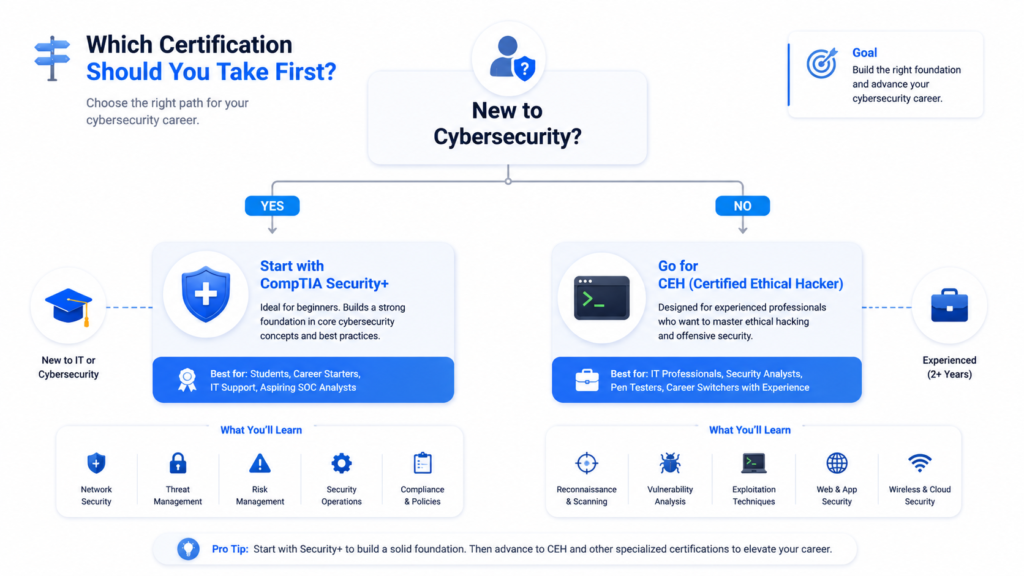
If you’re new to IT or cybersecurity → Security+ first
You’ll get a cheaper, prerequisite-free credential that hiring filters actually look for, and you’ll build the foundation CEH assumes. This is especially valuable for students and professionals enrolling in a cyber security course in Kochi who want to establish strong cybersecurity fundamentals before moving into advanced ethical hacking certifications like CEH. Taking CEH first would mean paying for training just to be eligible, then sitting a harder exam on shaky fundamentals, making Security+ the smarter starting point for most beginners.
If you already have 2+ years of security experience → CEH may be viable directly
You likely meet the eligibility requirement and have the hands-on base to handle the material. If your résumé already shows defensive depth, jumping to CEH can be a more efficient use of your next certification slot though Security+ is still a fast, cheap résumé checkbox if you lack it.
If you’re targeting government or DoD roles → check the job posting first
Both certs are 8140/8570-approved, but they satisfy different baselines. Security+ is the common IAT Level II requirement; CEH is often listed for offensive or analyst roles. Let the specific posting dictate the order rather than guessing.
If your goal is penetration testing specifically → Security+ first, then build toward hands-on certs
CEH is recognized and compliance-friendly, but it’s knowledge-heavy. Many hiring managers also want demonstrable, lab-based skill (OSCP, PenTest+, Hack The Box work). Use Security+ as the foundation, then choose CEH or a hands-on alternative based on whether the employer values the credential or the skill.
Career Outcomes and Salary
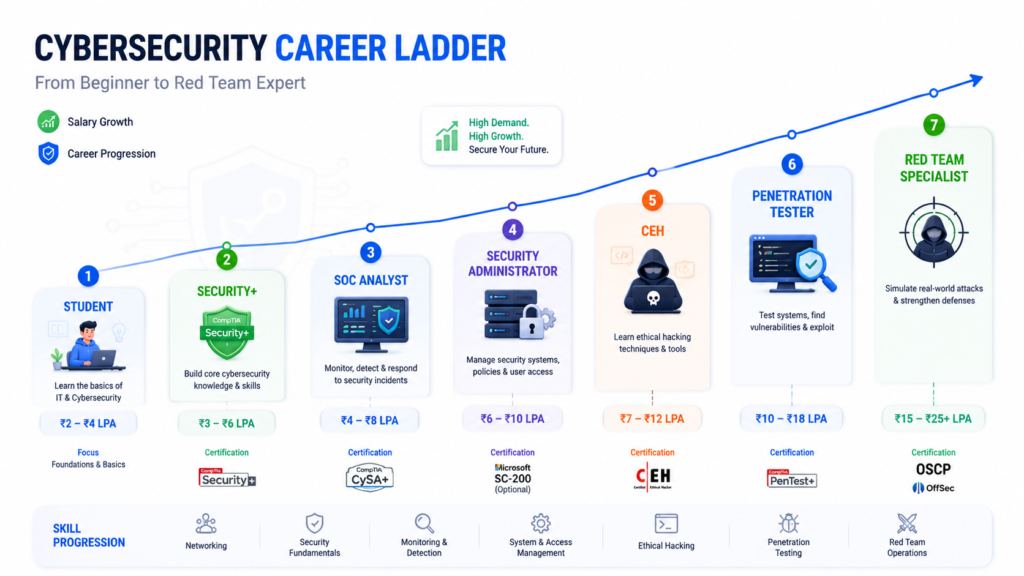
Salary tracks experience and role far more than the certificate itself, but the ranges still tell a useful story.
Security+ is a foundation credential tied to entry-level roles, and its value is partly procurement-driven: more than 700,000 professionals hold it largely because the US DoD approved it under Directive 8140. In India, it most often supports entry-level SOC analyst and security administrator roles, where pay commonly sits in the ₹ 4–8 LPA range early on and climbs with experience and stacked skills.
CEH holders in India, sitting in more specialized offensive roles, typically report salaries from around ₹ 6 LPA at entry to ₹ 18 LPA-plus with experience (senior offensive-security roles can run higher still). The honest read: CEH doesn’t cause that figure the roles it gates do. As a standalone resume line without experience, neither cert is a salary lever paired with hands-on work, both open doors.
The Recommended 2026 Certification Path
For the large majority of readers, the cleanest sequence is:
- CompTIA Security+ — foundation, eligibility-free, employer-recognized.
- CEH v13 or a hands-on cert (CySA+, PenTest+, eventually OSCP) — chosen by whether your target employers value the compliance checkbox or demonstrable skill.
Take CEH first only if you already have the two years of experience and a specific role demanding it. Otherwise, Security+ first isn’t the cautious choice it’s the efficient one.
FAQ
Should I take Security+ or CEH first? Most people should take Security+ first. It’s entry level, cheaper (₹38,000), and builds the defensive foundations CEH assumes you already have. CEH is intermediate and officially expects two years of security experience or formal training, making it a poor first step for newcomers to cybersecurity.
Is CEH harder than Security+? Yes. CEH v13 covers 550+ attack techniques across 20 modules with a four-hour, 125-question exam, while Security+ tests broader foundational concepts in 90 minutes. CEH also assumes hands-on networking and operating-system knowledge that Security+ candidates may still be building.
Can I take CEH without Security+? Yes. Security+ is not a formal prerequisite. However, EC-Council requires either official CEH training or two years of verified information security experience plus a ₹9,500 application fee to sit the exam. Without that background, most candidates struggle with CEH’s pace and depth.
Is Security+ enough to get a cybersecurity job? Often, for entry-level roles. Security+ is DoD 8140-approved and appears in a large share of cybersecurity job postings. It rarely lands a job alone, though pairing it with hands-on lab work, projects, or an internship significantly strengthens entry-level applications.
Which certification pays more, Security+ or CEH? CEH holders typically report higher salaries (roughly ₹ 6–18 LPA in India) because it targets more specialized offensive roles. Security+ is foundational and tied to entry-level pay. However, salary depends far more on experience and role than on the certificate itself.
Is CEH worth it in 2026? For compliance-driven and government-adjacent roles, yes CEH remains a widely requested DoD 8140 credential, and v13 now integrates AI-driven techniques. For pure skill validation, hands-on alternatives like OSCP are often preferred, so weigh CEH against your specific career target.
The Bottom Line
The real question isn’t which certification is “better” it’s which one fits where you are right now. If you’re newer to security, Security+ first is the cheaper, prerequisite-free, hiring-friendly move, and it sets up CEH to actually make sense later. If you already have two years of experience and a role that demands offensive skills, CEH can be a justified next step.