
In 2025, OWASP did something that would have been unthinkable two decades ago it moved Injection down to #5 in its famous Top 10. For a vulnerability that held the #1 spot for the better part of ten years, that looks like a victory. The reality is more uncomfortable. SQL injection still maps to more than 14,000 recorded CVEs, and 100% of applications tested by OWASP were checked for some form of injection because it remains that likely to appear.
So if the fixes are well-known and the tooling is mature, why is a flaw older than most of the developers writing code today still breaching systems in 2026?
The short answer: SQL injection didn’t get less dangerous. It got more invisible. It now hides inside ORMs, dynamic queries, legacy code, and a new generation of AI-assisted attacks precisely as the industry stops paying attention. This guide explains how the attack still works, why it persists, and exactly how to shut it down.
What Is SQL Injection?
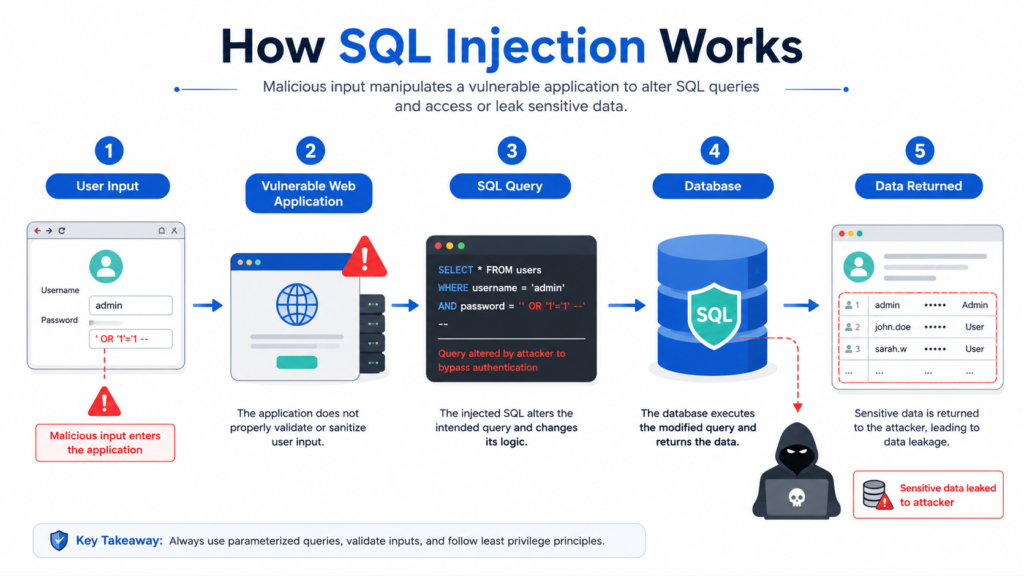
At its core, SQL injection is a confusion between data and commands. A web application builds a database query, and somewhere in that query it inserts something the user typed. If that user input is treated as part of the SQL command rather than as inert data, an attacker can rewrite the query’s logic.
The core flaw: when data becomes code
Imagine a login form that builds a query like this by gluing strings together: SELECT * FROM users WHERE username = ‘$user’ AND password = ‘$pass’
The developer expects $user to be a name. But SQL has no built-in way to know where “trusted command” ends and “untrusted input” begins. If the attacker controls part of that string, they control part of the query.
How SQL Injection Still Works in 2026
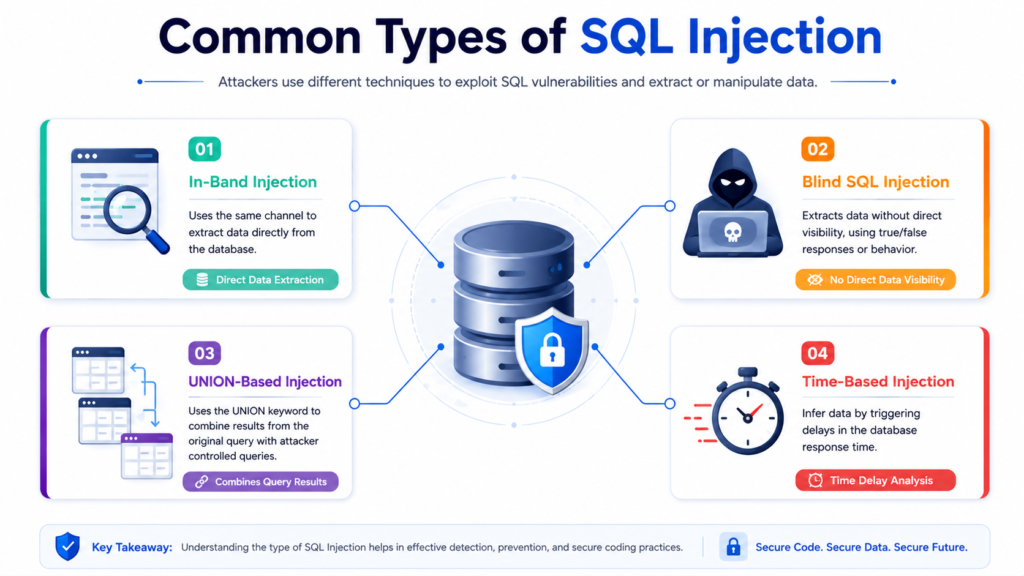
The mechanics haven’t changed, but the contexts where they surface have. Here are the forms still doing damage today.
Classic in-band injection
This is the most direct version, where the attacker injects and receives data through the same channel the web page itself.
- UNION-based attacks append a UNION SELECT to pull data from other tables into the visible result set, turning a product-listing page into a credential dump.
- UNION-based attacks append a UNION SELECT to pull data from other tables into the visible result set, turning a product-listing page into a credential dump.
These thrive wherever raw, string-concatenated queries still exist and they exist in far more codebases than teams like to admit.
Blind SQL injection
When an application shows no data and no error messages, attackers switch to blind techniques. Instead of reading data directly, they ask the database true-or-false questions and watch how the application responds.
- Boolean-based injection infers each piece of data by observing whether a page renders differently for true versus false conditions.
- Boolean-based injection infers each piece of data by observing whether a page renders differently for true versus false conditions.
Blind injection is slower and noisier, but automated tools make it trivial to run at scale, and it works even when an app reveals nothing on screen.
The 2026 vectors: ORM misuse and AI-generated payloads
This is what most articles miss. The two fastest-growing sources of SQL injection in 2026 aren’t new vulnerability classes they’re new blind spots.
The first is the ORM false-positive. Frameworks like Django, Hibernate, and Entity Framework parameterize queries by default, which leads many teams to assume injection is simply impossible in their stack. It isn’t. The moment a developer drops to a raw query, passes a user-controlled field name, or uses an unsafe API method, the protection evaporates. Real CVEs prove the point: Django’s CVE-2024-42005, for example, allowed SQL injection through maliciously crafted JSON keys passed to a “safe” .values() method.
The second is AI-assisted attack tooling. Attackers now use automated agents to discover injection points, generate obfuscated payloads, and bypass filters faster than manual testing ever allowed. The skill barrier that once protected obscure or awkward injection points is falling away.
Why It Still Happens After All These Years
If the primary fix is one line of code, the persistence of SQL injection is less a technical mystery than a human and organizational one.
The false sense of security from frameworks
The single biggest reason is complacency. Teams adopt a modern ORM, read that it prevents injection, and stop thinking about it. But research indicates that more than 30% of applications using ORMs still contain SQL injection vulnerabilities, almost always because of how the framework is used rather than the framework itself. Safe-by-default is not the same as safe-by-guarantee.
Raw queries, dynamic SQL, and legacy code
Every large codebase accumulates exceptions. A reporting feature needs a dynamic column name. A performance-critical path drops to raw SQL. A ten-year-old module nobody wants to touch concatenates strings the old way. Each of these is a candidate for injection, and they tend to be exactly the corners that automated scans and code reviews overlook.
Why WAFs catch some attacks but not all
Web application firewalls block many known injection patterns, and they’re genuinely useful. But attackers routinely slip past them using encoding tricks, inline comments, whitespace manipulation, and null bytes to disguise a payload that a signature-based filter doesn’t recognize. A WAF buys time and stops opportunistic noise; it does not fix vulnerable code underneath.
How to Stop SQL Injection: A Layered Defense
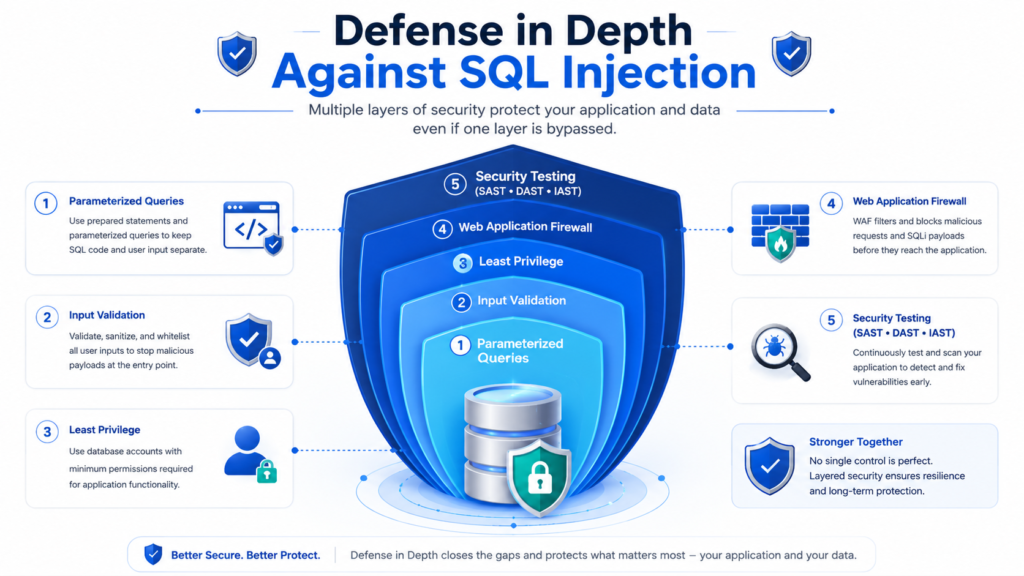
There is no single switch, but there is a clear hierarchy. Get the first item right and you eliminate the overwhelming majority of risk; the rest is defense-in-depth for everything else.
1. Parameterized queries (the primary fix)
Parameterized queries — also called prepared statements — are the most effective defense, full stop. They send the SQL command and the user data to the database separately, so input is never interpreted as part of the command. The earlier login query, written safely, looks like this:
SELECT * FROM users WHERE username = ? AND password = ?
The ? placeholders receive the values as pure data. No matter what an attacker types, it can never change the query’s structure. Almost every language and framework supports this natively. If you do one thing, do this.
2. Input validation and allow-listing
Validate input against strict, expected formats and prefer allow-lists (“only these characters/values are permitted”) over deny-lists (“block these bad ones”). Input validation is not a primary defense on its own, because legitimate input often contains special characters, but it’s essential for the cases parameterization can’t cover, such as user-supplied table or column names, which cannot be parameterized.
3. Least-privilege database accounts
The application should connect to the database with the minimum permissions it needs. A web app that only reads product data has no business holding DROP TABLE or administrative rights. If an injection does succeed, least privilege caps the blast radius.
4. WAFs and runtime monitoring (the backstop)
Deploy a WAF and database query logging as an outer layer. They won’t fix the root cause, but they detect and slow active attacks and give you visibility into suspicious patterns unusual UNION operations, unexpected table access, repeated failed probes.
5. SAST, DAST, and IAST in your pipeline
Build security testing into CI/CD. Static analysis (SAST) flags dangerous query construction in source code, dynamic analysis (DAST) probes the running app, and interactive testing (IAST) combines both. Catching injection before production is dramatically cheaper than catching it in a breach report.
How to Test Your Own App for SQL Injection
Testing your own systems is a core part of responsible security. Start with a source-code review: search the codebase for raw query construction and string concatenation around SQL—every +, every interpolated variable inside a query string is a candidate. Then run automated scanning in a controlled, authorized environment to surface points manual review misses. The goal is to find your weak spots before someone else does, then close them with parameterization. For aspiring security professionals learning these techniques in a cyber security course in Kochi, understanding how to identify and mitigate SQL injection vulnerabilities through ethical testing is a fundamental hands-on skill. Only ever test applications you own or have explicit permission to assess.
Frequently Asked Questions
Is SQL injection still a threat in 2026?
Yes. Although OWASP moved Injection to #5 in its 2025 Top 10, SQL injection still accounts for thousands of new CVEs each year and continues to appear in high-profile breaches. Legacy code, raw queries, and misused ORMs keep this decades-old vulnerability dangerously relevant.
What is the best way to prevent SQL injection?
Parameterized queries (prepared statements) are the single most effective defense, because they keep user input strictly separated from SQL commands. Layer this with input validation, least-privilege database accounts, and automated security scanning for robust, defense-in-depth protection that doesn’t rely on any one control.
Do ORMs like Django, Hibernate, or Entity Framework prevent SQL injection?
Mostly, but not automatically. ORMs use parameterization by default, yet developers reintroduce risk through raw queries, dynamic field names, and unsafe API methods. Research suggests over 30% of ORM-using applications still contain injection flaws, so ORMs reduce risk but never guarantee immunity.
What is blind SQL injection?
Blind SQL injection is a variant where the application returns no visible data or errors. Attackers infer information by asking the database true/false questions and observing changes in responses or timing. It’s slower and harder to exploit than classic injection, but equally capable of extracting sensitive data.
Can a web application firewall (WAF) stop SQL injection?
A WAF can block many known injection patterns and buys valuable time, but it should never be your only defense. Attackers routinely bypass WAFs using encoding tricks, comments, and inline obfuscation. Treat a WAF as a backstop layered on top of secure code, not a replacement for it.
Why is SQL injection still so common after 20+ years?
The fixes are well-known, but consistency fails. Developers concatenate strings under deadline pressure, inherit legacy code, or assume frameworks protect them. New AI-assisted attack tooling also lowers the skill barrier, letting attackers find and exploit overlooked injection points faster than before.
Conclusion: Boring Fundamentals Still Win
SQL injection is not an unsolved problem. We have known the fix for twenty years, it costs almost nothing, and it’s built into every serious framework. The vulnerability persists not because it’s hard to stop, but because stopping it requires consistency every query, every endpoint, every legacy corner, every time.
The OWASP demotion to #5 is not a reason to relax. It’s a warning that attention is drifting away from a flaw that is now better hidden than ever. Use parameterized queries everywhere, layer your defenses, test your own applications, and treat “use a modern framework” as a starting point rather than a guarantee. The teams that get breached in 2026 won’t be the ones who didn’t know the fix they’ll be the ones who assumed someone else had already applied it.