

Cryptography in cyber security is the reason a stolen laptop, an intercepted message, or a breached database doesn’t automatically hand an attacker anything usable. Every time you send a WhatsApp message, tap your card at a store, or log into your bank’s app, this is running in the background, doing one specific job making sure that if someone intercepts that data, it’s useless to them. Not hidden. Not deleted. Just mathematically scrambled beyond anything they can undo without the right key.
Most explanations of cryptography either stay so abstract they’re forgettable, or drop straight into math that loses the reader in the first paragraph. We test cryptographic implementations as part of our penetration testing labs at Offenso, and the honest truth is: you don’t need the math to understand this well enough to make smart security decisions. You need the right mental model. That’s what this guide gives you.
What Cryptography in Cyber Security Actually Does Behind the Scenes
Strip away the jargon and cryptography does exactly one of three things to your data:
- Locks it so only someone with the right key can read it (encryption)
- Fingerprints it so you can tell if it’s been tampered with (hashing)
- Proves who sent it so you can trust the source (digital signatures)
That’s the whole picture at a high level. Everything else AES, RSA, SHA-256, TLS is just a specific tool built for one of those three jobs.
A Short, Useful History (Why We Don’t Use Caesar Ciphers Anymore)
Julius Caesar reportedly shifted every letter in his messages by three positions A becomes D, B becomes E, and so on. It worked because nobody expected a coded message in the first place. That’s called security through obscurity, and it collapses the moment someone knows the trick exists.
Modern cryptography assumes the opposite: assume your attacker already knows exactly how your encryption works, has the source code, and has unlimited computing power for a reasonable amount of time. The only thing standing between them and your data should be the key a specific, secret value not the secrecy of the method itself. This principle, formalized in the 1880s by Auguste Kerckhoffs, is still the foundation every algorithm reviewed by NIST’s cryptographic standards program is judged against today.
The Three Building Blocks: Symmetric, Asymmetric, and Hashing
Symmetric Encryption
One key locks the data, and the same key unlocks it. Think of it like a physical padlock where you mail a copy of the key to whoever needs to open the box. It’s fast which is why it protects the actual content of your files, your hard drive, and your messages after a connection is already established.
The catch: both sides need the same key before they start, and getting that key to the other person safely is its own problem. That’s exactly what asymmetric encryption was invented to solve.
Asymmetric Encryption
Here, you get two mathematically linked keys instead of one: a public key you can hand out to literally anyone, and a private key you never share with anybody. Data locked with the public key can only be opened with the matching private key not even the person who encrypted it can reverse it without that private key.

This solves the key-sharing problem completely. Your bank can publish its public key to the entire internet, and anyone can send it encrypted data that only the bank’s private key can open. This is exactly how HTTPS gets a secure connection started before any actual data moves.
The tradeoff: asymmetric encryption is computationally heavier than symmetric encryption. That’s why real systems use it briefly at the start of a connection to safely agree on a shared symmetric key then switch to fast symmetric encryption for everything after that. TLS, the protocol behind the padlock icon in your browser, works exactly this way.
Hashing (Not Technically Encryption, and That Matters)
This is the one people mix up most often. Hashing takes any input a password, a file, a message and produces a fixed-length string that acts like a fingerprint. Critically, there is no key, and there is no way to reverse it back to the original input. That’s the entire point.
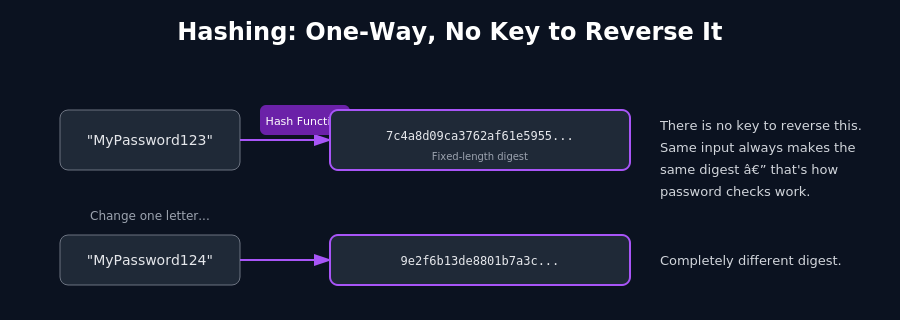
This is why a company that gets breached should never have your actual password sitting in their database they should only have the hash. When you log in, the system hashes what you typed and compares the two fingerprints. Even a single-character difference in the input produces a completely different hash, which is exactly what makes hashing useful for detecting whether a file has been tampered with.
Where Cryptography Is Working Right Now, Without You Noticing
| Everyday Action | Cryptography Doing the Work |
|---|---|
| The padlock icon in your browser | Asymmetric encryption negotiates a secure connection, then hands off to symmetric encryption (TLS) |
| Logging into an app with a password | Hashing compares your password’s fingerprint, not the password itself |
| Tapping your card at a store | Symmetric encryption protects the transaction data sent to the payment network |
| Sending a WhatsApp message | End-to-end encryption uses both asymmetric (key exchange) and symmetric (message content) methods |
| Downloading software updates | Digital signatures (built on asymmetric cryptography) confirm the update actually came from the real publisher |
| Storing files in the cloud | Symmetric encryption scrambles the file; access is gated by keys tied to your account |
Cryptography Algorithm Cheat Sheet
| Algorithm | Type | What It’s Actually Used For | Status in 2026 |
|---|---|---|---|
| AES (128/256-bit) | Symmetric | File encryption, VPNs, WhatsApp message content | Current standard, considered strong |
| RSA | Asymmetric | Key exchange, digital signatures | Still widely used, being gradually phased toward elliptic-curve alternatives |
| ECC (Elliptic Curve) | Asymmetric | Mobile devices, modern TLS | Preferred where processing power is limited |
| SHA-256 | Hashing | Password storage, file integrity, blockchain | Current standard |
| MD5 | Hashing | Legacy checksums | Broken — should not be used for security purposes anymore |
| DES | Symmetric | Older financial systems | Obsolete — key length is too short for modern hardware |
How Attackers Go After Cryptography
Attackers rarely try to break the math itself modern algorithms like AES-256 are not practically breakable by brute force with current technology. Instead, they go after the weaker points around the cryptography:
- Weak or reused keys — if the key is guessable or shared across systems, the strongest algorithm in the world doesn’t matter
- Outdated algorithms left running — MD5 and DES still show up in penetration tests on systems nobody’s updated in years
- Poor key storage — a private key sitting in an unprotected config file defeats the entire point of asymmetric encryption
- Implementation bugs — the algorithm is correct, but the code using it makes a mistake (predictable random number generation is a classic one)
- Downgrade attacks — tricking a system into using an older, weaker encryption method it still supports for compatibility
This is exactly why cryptography is treated as its own specialization within penetration testing rather than something bolted onto general system security most real-world failures aren’t in the math, they’re in how it’s implemented.
Mistakes We See Real Companies Make With Cryptography in Cyber Security
Weak cryptography in cyber security programs tends to fail in the same handful of ways, which is exactly why OWASP’s Cryptographic Failures category has consistently ranked among the top web application security risks in recent years:
- Storing passwords with plain hashing and no salt, making them vulnerable to precomputed lookup tables (rainbow tables)
- Hardcoding encryption keys directly into application source code
- Continuing to support outdated protocols (like SSL or early TLS versions) for the sake of compatibility with old devices
- Encrypting data in transit but leaving it unencrypted at rest on the server
- Rolling out custom, in-house encryption instead of using established, peer-reviewed algorithms — a practice security researchers call “rolling your own crypto,” and it consistently ends badly
Where This Fits Into a Cybersecurity Career
Cryptography shows up across nearly every cybersecurity role, not just as a standalone specialty. A SOC analyst needs to recognize when TLS is misconfigured. A penetration tester needs to know how to identify weak hashing before an attacker does. Digital forensics investigators rely on hashing to prove evidence hasn’t been altered.
At Offenso, cryptography in cyber security is built into the core curriculum precisely because it’s not optional knowledge for any of these paths it’s part of the connective tissue running through the entire field. If you’re evaluating which course fits your goals, our Advanced Diploma in Information Security covers cryptography alongside network and web application security in depth.
Cryptography FAQ
What is cryptography in cyber security? Cryptography in cyber security is the practice of using mathematical techniques to protect data through encryption (locking data so only a key can unlock it), hashing (fingerprinting data to detect tampering), and digital signatures (proving who sent something).
Is cryptography the same thing as encryption? No. Encryption is one part of cryptography. Cryptography is the broader field that also includes hashing, digital signatures, and key management —encryption specifically refers to the locking/unlocking of data.
Can encrypted data ever be hacked? Properly implemented modern encryption (like AES-256) is not practically breakable through brute force with current computing power. Real-world breaches almost always exploit weak keys, poor implementation, or stolen credentials not the encryption algorithm itself.
Why do websites switch from HTTP to HTTPS? HTTPS adds a layer of encryption (TLS) on top of the standard HTTP protocol, protecting data in transit between your browser and the website’s server from being read or altered by anyone intercepting the connection.
What happens to encrypted data if the key is lost? It becomes permanently unreadable in almost all cases that’s the entire point of encryption. This is why key management and secure backup of encryption keys is treated as seriously as the encryption itself in enterprise security.
Will quantum computers break current encryption? Sufficiently advanced quantum computers are expected to eventually break widely-used asymmetric algorithms like RSA, which is why “post-quantum cryptography” is an active area of research and standardization. Symmetric encryption like AES is considered more resistant, though larger key sizes are recommended as a precaution.